

Hybrid adhesive sealant: what is it?
Hybrid sealants, known mostly as MS polymers or SMP (Silyl Modified Polymer), were first introduced by the Japanese company Kaneka about 40 years ago. They are a hybrid polymer of polyurethane and silicone. The material obtained by crossing polyurethane with silicone has the strengths of both and is free of their weaknesses.
Where hybrid polymer materials are used
The range of applications of hybrid polymer materials follows from their all-round properties and is therefore extremely wide: they are used as adhesives and sealants in construction, in the home, and in the aircraft, automotive and shipbuilding industries.
Key benefits
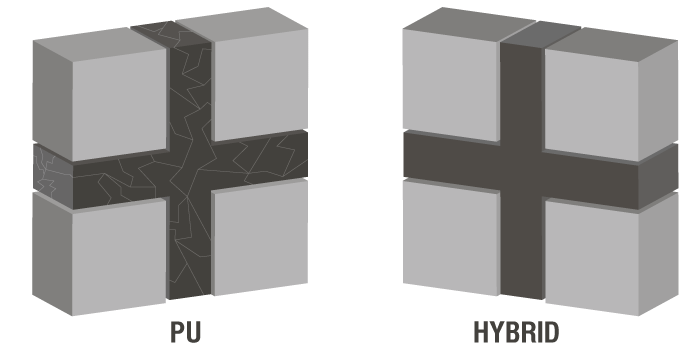
UV resistant
Unlike polyurethanes, which break down quickly under sunlight, hybrid polymers are not affected by UV. Exterior joints filled with hybrid adhesive sealants do not need to be protected from sunlight.
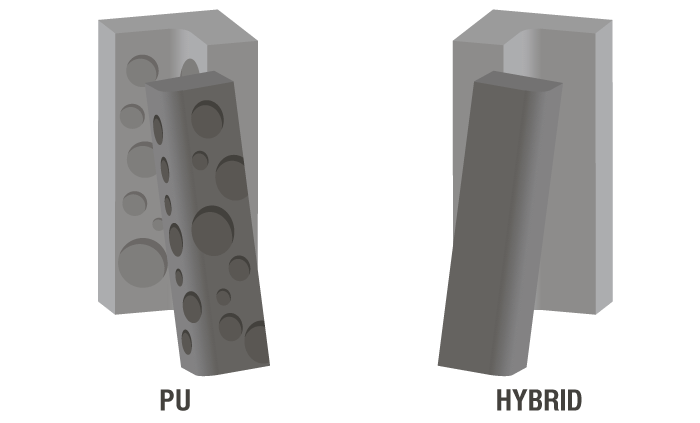
Solid structure with no pores
Polyurethane sealants have a porous structure, because carbon dioxide bubbles form inside them while they cure. A porous structure is not as strong as a solid one. Hybrid sealants provide excellent adhesion on both dry and damp surfaces. No carbon dioxide is formed in them, so they have no pores either.
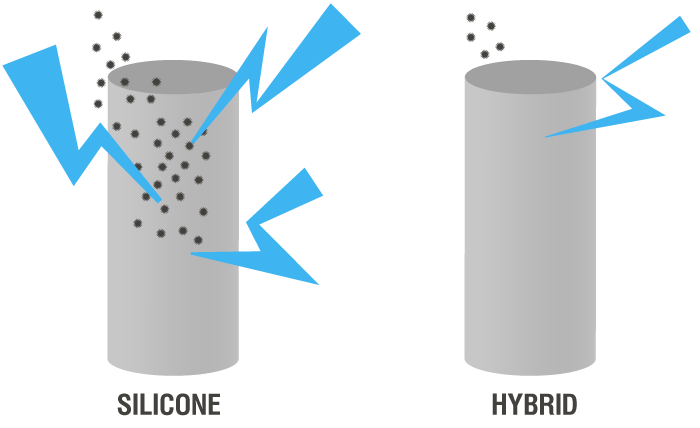
Do not build up static electricity
Unlike silicone sealants, hybrid sealants do not build up static electricity and therefore do not attract dust. Joints made with hybrid polymers stay clean.
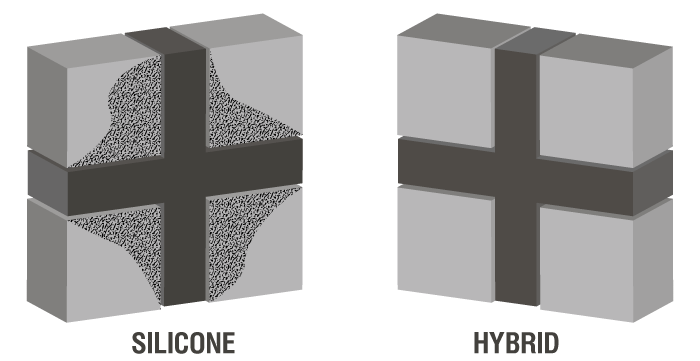
Contain nothing that migrates into the porous materials around the joint
Silicone sealants contain oils as a plasticizer, and these oils migrate into the porous materials around the joint. As a result, a greasy halo appears over time on concrete, stone and other porous materials around the joint, which looks untidy. Dust and dirt also stick to a joint that "sweats" oil, forming brown streaks over time, which does nothing for the look of the joint either. The plasticizer contained in a hybrid reacts completely with the other components of the sealant and does not bleed into the porous materials around it, so joints made with a hybrid polymer keep a neat appearance for a long time.

Solvent-free
Unlike a polyurethane one, a hybrid adhesive sealant contains no solvents that evaporate over time, so joints made with it do not shrink.

Easy to paint over
Unlike silicone ones, joints made of hybrid polymers can be painted with any type of paint.

Excellent adhesion to all materials
Hybrid materials have excellent adhesion to almost all materials. On top of that, some hybrid adhesive sealants have very high initial tack: a heavy part only has to be pressed firmly against a vertical surface and can then be released at once, with no risk of it sliding down or falling off. This makes the work considerably simpler and faster.
Hybrids are a new generation of adhesive sealants that differ from silicone and polyurethane ones in being more versatile and in performing better.


